.jpg)

When people discuss risk in social care, the conversation often focuses on staffing, compliance, safeguarding, occupancy, finances and inspections.
However, one of the most significant risks facing care providers today is often overlooked.
Leadership burnout.
Across the care sector, owners, directors, registered managers and senior leadership teams are operating under increasing pressure. Many are managing workforce shortages, rising costs, regulatory scrutiny and operational challenges simultaneously.
As a result, leadership burnout is no longer simply a wellbeing issue.
It is becoming a business continuity risk.
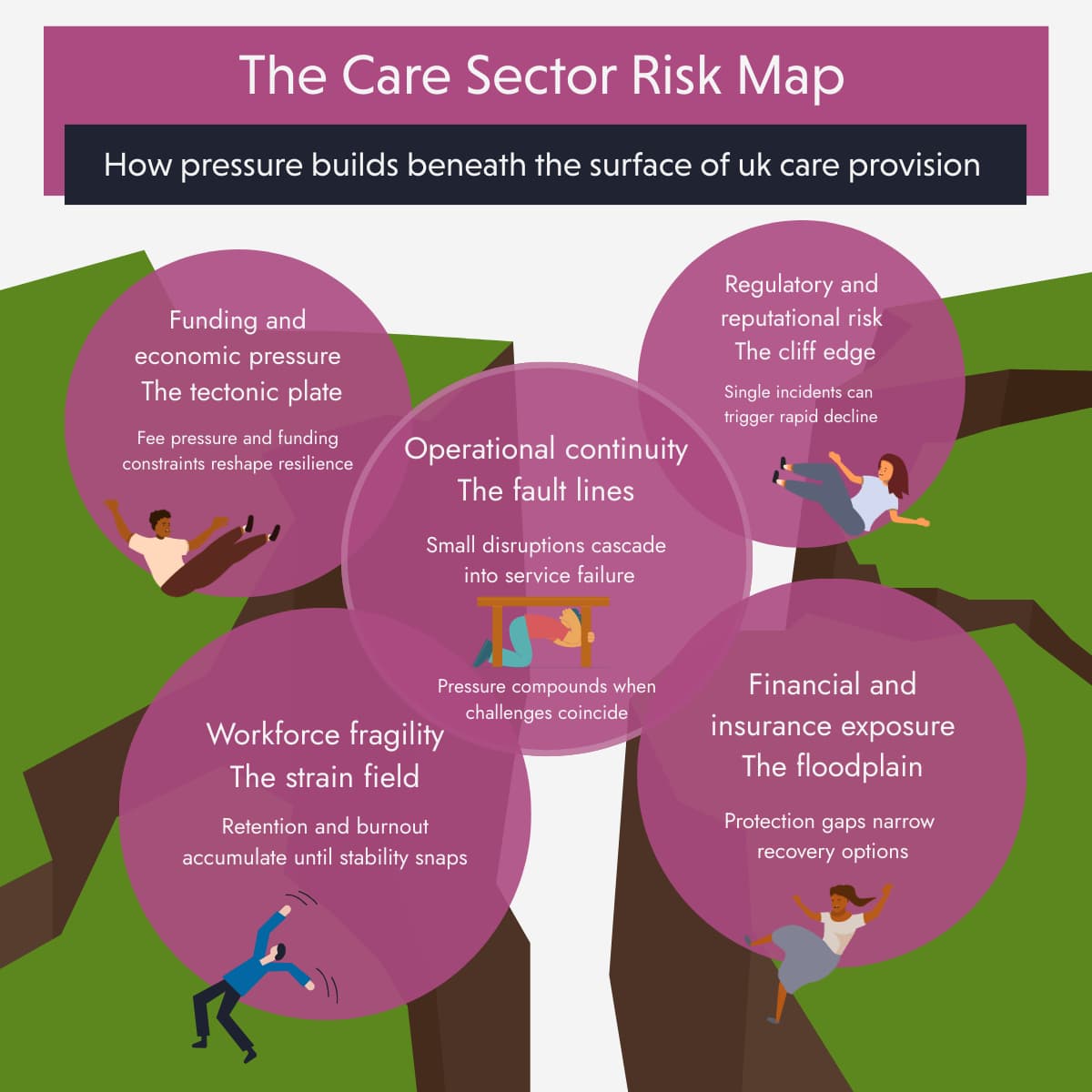
Leadership burnout occurs when prolonged periods of stress, pressure and responsibility begin to impact an individual's ability to perform effectively.
For care leaders, this can develop gradually as they balance:
Unlike frontline burnout, leadership burnout often remains hidden because leaders frequently feel unable to step back or ask for support.
Leadership burnout can affect far more than the individual experiencing it.
When senior leaders become overwhelmed, organisations can begin to experience:
These issues rarely appear overnight.
More often, they build gradually through delayed decisions, unresolved problems and increasing operational pressure.
One of the biggest concerns for care providers is what is often referred to as Key Person Risk.
This occurs when critical knowledge, relationships or responsibilities sit with a small number of individuals.
Many care organisations rely heavily on owners, directors, registered managers or senior leaders who hold significant operational knowledge.
If one of these individuals becomes unavailable due to illness, stress, burnout or resignation, the impact can be substantial.
Questions providers should ask include:
The answers may reveal vulnerabilities that have never been formally assessed.
Leadership burnout rarely arrives suddenly.
Common warning signs include:
The challenge is that these behaviours often become normalised within busy organisations.
By the time problems become visible, performance, culture or compliance may already be affected.
Leadership resilience plays an important role in maintaining stable and effective services.
When leadership teams become overstretched, organisations may experience:
The strongest care organisations increasingly view leadership resilience as part of their risk management strategy.
Rather than relying on a small number of individuals, they invest in:
These organisations recognise that resilient services are built on resilient leadership teams.
Reducing leadership risk starts with recognising that resilience is not the same as unlimited capacity.
Practical steps include:
By addressing these areas proactively, providers can reduce the risk of disruption and strengthen long term sustainability.
If your senior leadership team had to step away for a month tomorrow, would your organisation continue operating effectively?
Or are too many critical responsibilities concentrated in too few hands?
The answer may highlight one of the most significant hidden risks within your organisation.
What is leadership burnout?
Leadership burnout is a state of physical, emotional and mental exhaustion caused by prolonged workplace pressure and responsibility.
Why is leadership burnout a business risk?
It can affect decision making, compliance, workforce stability, service quality and business continuity.
What is key person risk in social care?
Key person risk occurs when critical knowledge or responsibilities are concentrated within a small number of individuals.
How can care providers reduce leadership burnout?
By investing in succession planning, delegation, leadership development, workforce stability and business continuity planning.
At Quality Care Group, we work with care providers to identify and manage operational risks that affect long term sustainability.
This includes support around:
Effective risk management is not just about protecting buildings, assets and policies.
It is also about protecting the people responsible for leading them.
Future topics include:
Agency Dependency Risk
Occupancy Vulnerability
Claims and Insurance Exposure
Financial Pressure Mapping
Reputation and Reputation Recovery Risk
Acquisition and Growth Risk
Digital and Cyber Risk
Start The Conversation
If you would like to discuss leadership resilience, operational risk or business continuity planning within your organisation, start the conversation with our team today.
.jpg)
Read the first article in this series here: Risk #1 Why Is Workforce Instability One of the Biggest Risks Facing Care Providers?